
Parque Lleras Crackdown: What It Means for Medellín Travelers
Medellín’s best-kept secret is outside the city
Last updated: October 2026
Medellín is one of the best bases in South America for outdoor adventure. Within under two hours of El Poblado you can paraglide over the Cauca River valley, go white water rafting on Class III and IV rapids, rappel down jungle waterfalls, and ride ATVs or gravity mountain bikes through coffee and cattle country. Most visitors never hear about any of it.
It’s an odd situation for a city built in a valley full of mountains and rivers. For years the conversation about Medellín has started and ended with its nightlife. We’ve run private adventure tours here since 2015, and we still meet travelers on their last day who had no idea what was 90 minutes from their hotel. That is starting to change. This October, police raids in Parque Lleras, the center of Medellín’s nightlife, made news across Colombia, and the city has made it clear what kind of visitor it wants.
How the party town image buried the mountains
Two stories have defined Medellín abroad. First came the cartel years of the 1980s and 1990s. Then, once the city had rebuilt itself, came the idea of Medellín as a cheap party destination where anything goes. Streaming series and travel influencers sold Parque Lleras and Provenza as if they were the whole city.
That image did real damage. It attracted visitors who had little interest in Colombia itself, and it put off the ones who would have loved it. A couple planning a hiking and rafting trip would look at Medellín coverage, see bottle service and nightclubs, and book Costa Rica instead.
It also hid the geography. Medellín sits at about 1,500 meters in the Aburrá Valley, on the edge of the Andes. Drop west toward the Cauca River and you lose 1,000 meters of altitude and gain 10 degrees of heat. Head east and you are in the rivers and canyons of the Magdalena watershed. We can’t think of many cities with that much variety this close.
What’s happening at Parque Lleras
If you’ve seen videos from Parque Lleras this month, here is the background. The park, in El Poblado, is the heart of Medellín’s nightlife. In October 2026 it is also the focus of the city’s biggest push against the crime that grew up around it.
Under Plan Lleras, which started in March 2024, police, the army and Migración Colombia run regular operations in the area. Officers inspect bars and ask people on the street for their papers, foreigners included. The city reports more than 430 arrests in about 1,000 days, aimed at human trafficking, sexual exploitation, drug dealing, extortion and scopolamine robberies (Infobae). In September, Migración ordered 17 foreigners with criminal records expelled after raids in Lleras and nearby Barrio Antioquia (Semana).
The clean-up has a cost. Bar owners in the area report sales down by as much as 85 to 90%, and the local bar association has gone from 24 member businesses there to 7 (Agencia PI). Many of those owners run honest businesses and support the crackdown. High rents and rising labor costs are hurting them too.
For travelers the advice is simple. Carry your passport, expect police on the street at night, and don’t mistake Lleras for the whole of Medellín. It never was.
Medellín is cleaning up its image
The Parque Lleras crackdown is part of a wider shift. The city is now openly choosing what kind of visitor it wants. Since 2024 Mayor Federico Gutiérrez has led a public campaign against sex tourism and the criminal groups behind it, and the national government has backed it.
Here is what has changed:
- In May 2026 the city presented its Plan Distrital de Seguridad Turística 2026–2030, a five-year plan aimed at reducing crimes linked to tourism, including the sexual exploitation of minors, human trafficking and theft (Alcaldía de Medellín).
- In 2025 inspectors checked 125 hotels and suspended 62 of them, and found problems in 51 of 135 short-term rentals they reviewed (same source).
- Migración Colombia keeps turning away foreigners flagged for sex tourism at Medellín’s airport. By late July 2026 its Antioquia office had counted more than 140 refusals for the year, against 80 in Antioquia for all of 2025 (El Tiempo, Diario Occidente).
- In October 2026 the city put up English-language billboards around Parque Lleras with a blunt message for would-be offenders: don’t even try it, it’s a crime (Telemedellín).
- The city created its first Secretaría de Turismo, which says it wants to grow sports, health and nature tourism (La Silla Vacía).
Travelers are responding. Medellín received 1.2 million foreign visitors in 2025, and about a third came from the United States (Travel Agent Central). City officials are pushing those visitors beyond Comuna 13 and toward nature, pointing out that close to 70% of the municipality is green space (same source).
We’re glad to see it. Our clients come here to raft rivers and fly over valleys, and the city is finally making room for them.
The best outdoor adventures near Medellín
Every activity below is a day trip from Medellín. You leave after breakfast and you are back for dinner.
- Tandem paragliding
Where: Sopetrán and San Jerónimo, Cauca River valley
Best for: first-timers who want big views with zero experience - White water rafting (Class III and IV)
Where: rivers of eastern Antioquia
Best for: groups who want a full day on the river - Canyoning
Where: Cocorná
Best for: fit travelers who like waterfalls and ropes - ATV tours
Where: western Antioquia countryside
Best for: riders who want dirt roads and farm country - Via ferrata
Where: rock walls near Medellín
Best for: climbing without a climbing background - Gravity mountain biking
Where: mountain descents outside the city
Best for: riders who want a Death Road style descent without flying to Bolivia - Guatapé and El Peñol
Where: Guatapé
Best for: a classic day that mixes the lake, the rock and adventure add-ons
Paragliding over the Cauca River valley
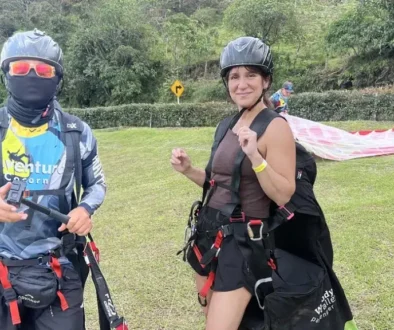
This is where we started. Our founder flew on Colombia’s national paragliding team and has spent about 18 years in the Sopetrán area, west of the city. The valley produces steady thermals most of the year, which makes it one of the more reliable flying sites in South America. You fly tandem with a certified pilot, so you need no training. Once you’re up, you can see the river below and the Andes on both sides.
White water rafting and canyoning in eastern Antioquia
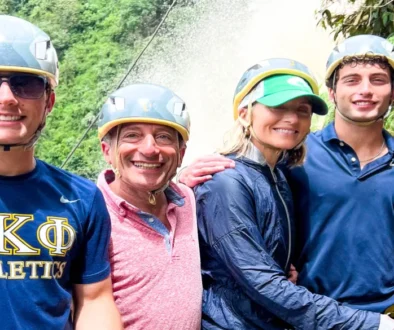
East of Medellín the land breaks into steep, wet canyons fed by mountain rivers. White water rafting here runs Class III and IV rapids with jungle on both banks. Class III water means big waves and lines your guide has to read. Class IV is stronger and more technical, and everyone in the raft paddles hard through it. Canyoning near Cocorná is a different kind of day: you walk, swim and rappel down a river, including waterfalls you descend on a rope.
ATVs and via ferrata
For a day on land, an ATV tour takes you through the dirt roads and small farms of the countryside. Via ferrata routes use fixed steel cables and rungs, so you can climb an exposed rock face safely without knowing how to lead climb.
Gravity mountain biking, Antioquia’s answer to the Death Road
If you’ve heard of riding Bolivia’s Death Road, the old North Yungas Road outside La Paz, you already know how gravity biking works. A support vehicle carries you and the bike uphill, and you spend the day riding down. The Death Road drops about 3,500 meters over roughly 64 km, from the cold pass at La Cumbre into the Yungas jungle, and it is one of the best-known rides in South America.
Our gravity mountain biking tour follows the same idea with a 40 km ride and a 2000 meter drop on a mountain road outside Medellín. You get the long descent and the scenery changing around you, without the crowds of backpacker groups or the flight to La Paz.
Guatapé, done differently
Most people see Guatapé from a crowded tour bus. On a private Guatapé day trip you set the pace: climb the 740 steps of El Peñol, walk the painted streets of the town, and spend time out on the water.
Why now is the time to visit Medellín
With the Parque Lleras crackdown in full swing, the city wants the same visitors we do. The city is now openly choosing what kind of visitor it wants. Officials are courting people who come for the landscape and the culture, and they are backing that up with inspections and deportations.
The adventure scene is also still uncrowded. Compare a rafting day here with one in Costa Rica or a paragliding flight with one in the Alps. You will share the river and the sky with far fewer people, and a private tour still means private.
And the weather barely changes. Medellín’s “eternal spring” climate holds at roughly 22 to 28 °C through the year, with two wetter seasons. Most of these activities run year round. Rain mostly arrives in the afternoon, so we schedule flights and river days for the morning.
Frequently asked questions
Is Medellín safe for tourists in 2026?
Medellín is safe for travelers who use normal big-city sense. In 2026 the city launched a five-year tourism security plan and stepped up inspections of hotels and rentals. Most problems involve tourists looking for drugs or sex at night. Visitors on daytime outdoor tours with a registered operator rarely run into trouble.
What are the best outdoor activities near Medellín?
The top outdoor activities near Medellín are tandem paragliding in Sopetrán and San Jerónimo, white water rafting and canyoning in eastern Antioquia, ATV tours, via ferrata climbing and a day in Guatapé. All of them work as day trips, with most sites between one and three hours from El Poblado.
Do I need experience for paragliding or rafting near Medellín?
No experience is needed for tandem paragliding or guided rafting near Medellín. In tandem paragliding a certified pilot flies the wing while you sit in front. Rafting guides give a full safety briefing before you launch. For rafting and ATV tours the minimum age is 16.
When is the best time of year for adventure tours in Medellín?
Medellín works for adventure tours all year thanks to its mild climate. December to March and July to August are usually the driest months. The wetter seasons bring afternoon rain, so we run flights and river trips in the morning.
Is Parque Lleras safe to visit during the crackdown?
Parque Lleras has a heavy police presence in late 2026 as part of Medellín’s crackdown on trafficking, drugs and sexual exploitation. Expect bar inspections, pat downs, and ID checks, so carry your passport. Visitors out for dinner or a drink rarely have problems, but the area is much quieter than it used to be.
Are your tours private?
Yes. Guanabana Tours runs only private, English-guided tours for a minimum of two people. We never add strangers to your group.
Plan your Medellín adventure
Medellín’s nightlife will probably keep getting the headlines. The mountains around the city are why we’ve stayed here for more than a decade. Guanabana Tours S.A.S. has run private adventure tours in Antioquia since 2015 (RNT 47842), with five-star ratings on Google and TripAdvisor.
See all tours and prices on our price list, or send us your dates through the contact page and we will put together your trip.
Sources: Alcaldía de Medellín, Plan Distrital de Seguridad Turística 2026–2030 · Travel Agent Central, 1.2 million foreign visitors in 2025 · Infobae, Parque Lleras operations · Semana, 17 expulsions · Agencia PI, Lleras business closures · El Tiempo, Migración Colombia refusals in 2026 · Diario Occidente, 2025 refusals · Telemedellín, Parque Lleras billboards · La Silla Vacía, new Secretaría de Turismo